
Carroll Projected and Actual Release
A projected release date is a working calculation. It is not the same as the actual timestamp when someone leaves a jail or prison. The calculation can reflect the court term, sentence start, presentence credit, applicable diminution credit, concurrent or consecutive sentences, and any known legal hold. “Diminution credit” means time deducted from a term under the rules that apply to the sentence.
Several dates can exist at once. A court-imposed maximum is not a parole-eligibility date. Parole eligibility only marks when the Maryland Parole Commission may consider release. A mandatory or conditional release calculation reflects a sentence reduced by lawful credits. The actual release date records what happened after legal and facility processing. Probation or supervision may then continue beyond the custody date.
Pretrial custody works differently. Someone held at Carroll County Detention Center while a case is pending has no sentence-based release date. Bond, recognizance, dismissal, a new court order, or another case can change custody. A signed order may also come before the jail completes processing.
Find Carroll County Projected Release
The correct route depends on whether the person serves a local term or a Maryland state sentence. Carroll County Detention Center’s Inmate Records Unit tracks local sentence length and diminution credits. DPSCS maintains state commitment, movement, calculation, parole, mandatory-release, actual-release, and discharge records. Maryland Judiciary Case Search provides the sentencing docket, but the docket is not the facility’s movement log.
- Identify the custodial system from the court case, facility name, or verified agency information.
- For a local sentence, call CCDC at 410-386-2628 and ask for Inmate Records or the records custodian.
- For a state term, check the DPSCS locator only for a current facility, not a projected date.
- Request the nonexempt sentence-calculation and release fields from the appropriate records office.
- Compare the agency calculation with the sentencing docket, including presentence credit and concurrent or consecutive terms.
- Ask about another commitment, detainer, amended order, credit loss, or parole condition if the dates differ.
A precise local request should identify the person, booking episode, case number if known, and approximate custody dates. Ask for the sentence-calculation or credit record, expected release calculation if disclosable, release authority, and actual release transaction once complete. Some fields may be withheld under Maryland law, but the custodian can identify the proper office or explain a lawful denial.
The Carroll County release record search covers the wider path for confirming a person after release, including VINE and court records. A projected-date inquiry stays focused on the calculation maintained by the jail or state corrections agency.
Note: A court sentence gives the legal term, while the custodial agency applies credits and records the date of physical release.
Carroll State Release Locator Limits
Maryland calls its public tool the Incarcerated Individual Locator. Its purpose is to show facility information for people currently held in covered DPSCS institutions. The public form uses first and last name. DPSCS states that people no longer in custody for any reason are not listed.
The Carroll County projected release answer is therefore a negative finding: the public locator has no projected, tentative, mandatory-release, or maximum-expiration field. It also does not return a former prisoner with a public “released” or “discharged” result. A no-match cannot prove release because spelling, timing, an excluded population, or a different custody system can produce the same response.
| Public locator item | Maryland finding |
|---|---|
| First name | Public search input for current covered custody. |
| Last name | Public search input for current covered custody. |
| Current institution | A returned state facility indicates current state custody, not release. |
| Former inmates | Not listed after they are no longer in custody. |
| Projected release date | Not exposed as a public locator field. |
| Historical release record | Must be sought through DPSCS records, subject to law and agency rules. |
Use the DPSCS Public Information Act process for a former state prisoner or an individual calculation. Include a DOC number when known, the committing court and case, likely institution, and approximate dates. Specify the fields sought, such as admission, movements, calculation sheet, mandatory-release date, release authority, actual release date, release type, and discharge or supervision status.
The official DPSCS records page shows the documentary fallback when the current-custody locator cannot answer a Carroll County release-date question.
This route seeks the underlying state record. It does not turn the public current-custody locator into a release-history database.
Carroll State Release Credit Rules
State-prison terms use Maryland Correctional Services Article Title 3. Section 3-702 establishes the general entitlement to diminution credits and exclusions. Under Section 3-704, the general advance good-conduct rate is ten days for each calendar month, prorated for a partial month. The rate is five days per month when the aggregate term includes a crime of violence or specified drug offenses cited in that statute.
Other credits have separate rules. Section 3-705 allows five days per month for satisfactory assigned work. Sections 3-706 and 3-707 address education and special projects or programs. Section 3-708 caps total monthly deductions, so the figures cannot simply be added without checking the person’s category, offense date, term, and current statutory text. Credit is also not earned for specified periods such as escape, some noncustody time, a stayed sentence, or parole-revocation time for which credit is declined.
Section 7-501 governs conditional release after the term less applicable credits. For an eligible violent crime committed on or after October 1, 2009, conditional release cannot precede the parole-eligibility point set by the cited law. Conditional release usually carries mandatory supervision for the unserved balance. It is not an unconditional end to the sentence.
The Maryland diminution-credit statutes are the source behind state release calculations.
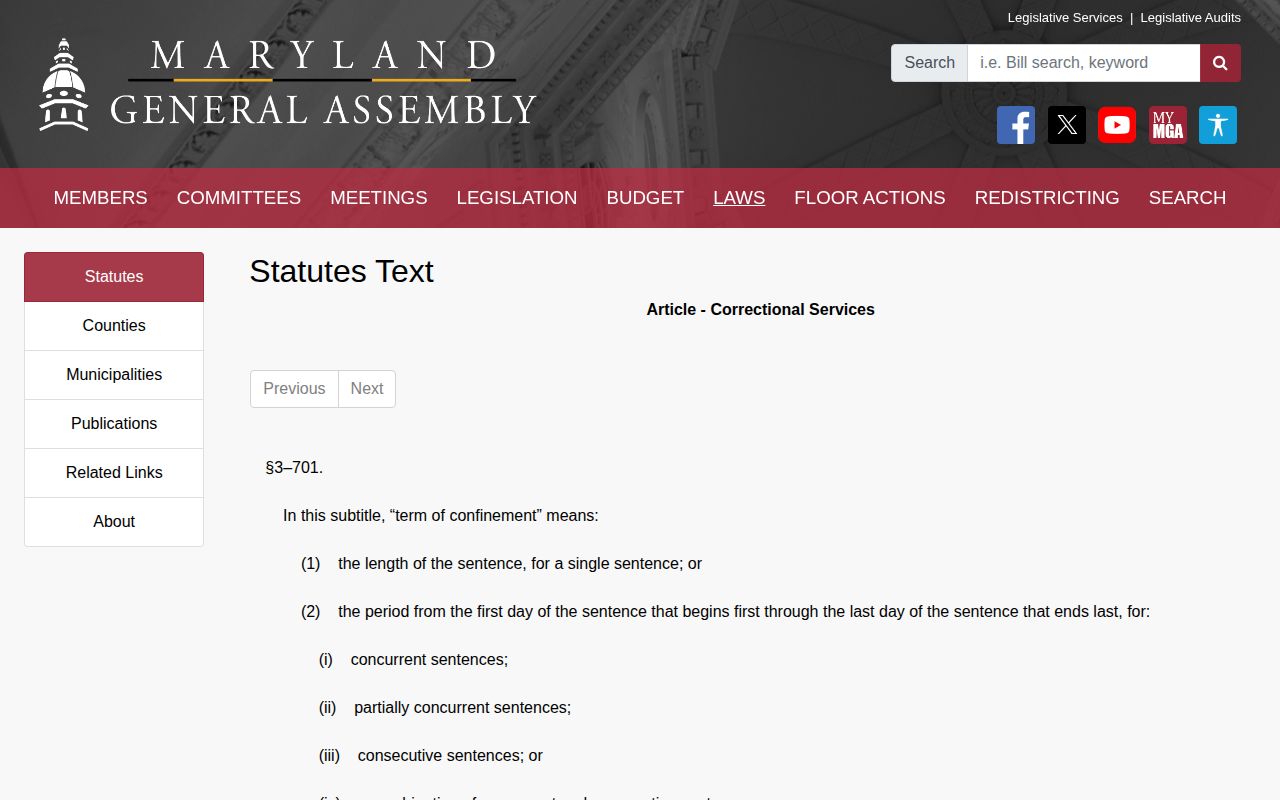
The statute confirms that release credits are rule-based and sentence-specific, not a flat percentage that can be applied from a docket alone.
Carroll Local Release Credit Rules
A local CCDC term does not use the state-prison formula by default. Maryland Correctional Services Title 11, Subtitle 5 governs local sentence credits. Section 11-502 establishes local entitlement and exclusions. Sections 11-503 and 11-504 address presentence and postsentence good conduct, while Sections 11-505 and 11-506 cover work and special projects.
Section 11-507 permits credit revocation through the required disciplinary process. The Carroll County Sheriff also says Inmate Records tracks diminution credits earned through work assignments and trustee supervisory positions. The record maintained by that unit is therefore central to a local projected release date.
The calculation can depend on sentence commencement, presentence credit, concurrent or consecutive structure, offense and date, local conduct or work credits, forfeiture or restoration, a stayed term, another case, and a detainer. A detainer is a request or legal hold from another authority. It can prevent release to the community even when one sentence reaches its calculated date.
Do not subtract a generic credit figure from the court sentence. Ask CCDC for the maintained calculation and compare it with the Carroll court docket. The court explains the legal term, while Inmate Records applies the local custody facts.
Carroll Parole Release Date Rules
Maryland research does not support a blanket claim that every inmate serves 85 percent. The rules are offense-specific and sentence-specific. Under current Section 7-301, the ordinary eligibility baseline for a sentence of six months or more is one-fourth of the aggregate term. A state sentence for a qualifying crime of violence committed on or after October 1, 1994 uses the greater of one-half of the aggregate violent-crime sentences or one-fourth of the total aggregate sentence, while also respecting any ineligible component.
Life terms and specified repeat drug cases use other statutory thresholds. Administrative release under Section 7-301.1 is narrower and has its own offense, case-plan, conduct, and hearing conditions. None of these eligibility dates promises release.
The Maryland Parole Commission may refuse parole, set a rehearing, or approve release subject to prerequisites. A plan, program, detainer, rule issue, or release processing can delay an approved event. Parole means conditional release during a sentence, usually with Division of Parole and Probation supervision. Discharge means the relevant sentence or supervision authority has ended.
Note: Parole eligibility is a date for possible consideration, not the Carroll County inmate’s scheduled or guaranteed day of release.
Why Carroll Release Dates Change
A projected date moves when a fact used in the calculation changes. Some changes come from the court. Others come from credits, discipline, parole action, or a second authority. The actual release timestamp may also follow the order because the facility must complete its process.
| Change | Effect on the release calculation |
|---|---|
| Amended sentencing order | Changes the legal term or how parts of the sentence run. |
| Presentence credit correction | Adds or removes credited custody time applied to the term. |
| Concurrent or consecutive treatment | Changes whether terms overlap or run one after another. |
| Credit earned, revoked, or restored | Moves the conditional or projected date under the governing statute. |
| Parole decision or condition | May deny, defer, suspend, or condition release without changing the maximum term. |
| Another commitment or detainer | May shift the person to another custody source instead of the community. |
Ask which source changed the date. A new court order belongs in the docket. A credit decision belongs in the jail or DPSCS calculation. A parole action belongs with the Parole Commission. A detainer may require the agency that issued it. Keeping the source attached to the change prevents a tentative date from being repeated as a fixed promise.
Carroll Community Release Projections
DPSCS publishes a Community Releases dashboard that can be filtered by county. Its county measure is based on reentry home plans. It excludes transfers to other correctional custody and deaths. That makes it useful for aggregate planning context, not a search for one named Carroll County inmate.
The dashboard’s projected home-plan count does not prove that each planned release took place. It also does not supply an individual release date or replace a sentence-calculation record. A person may plan to return to Carroll County while serving time elsewhere in Maryland, so the county filter should not be read as a CCDC release list.
The official DPSCS Community Releases view shows how Maryland presents aggregate release projections.
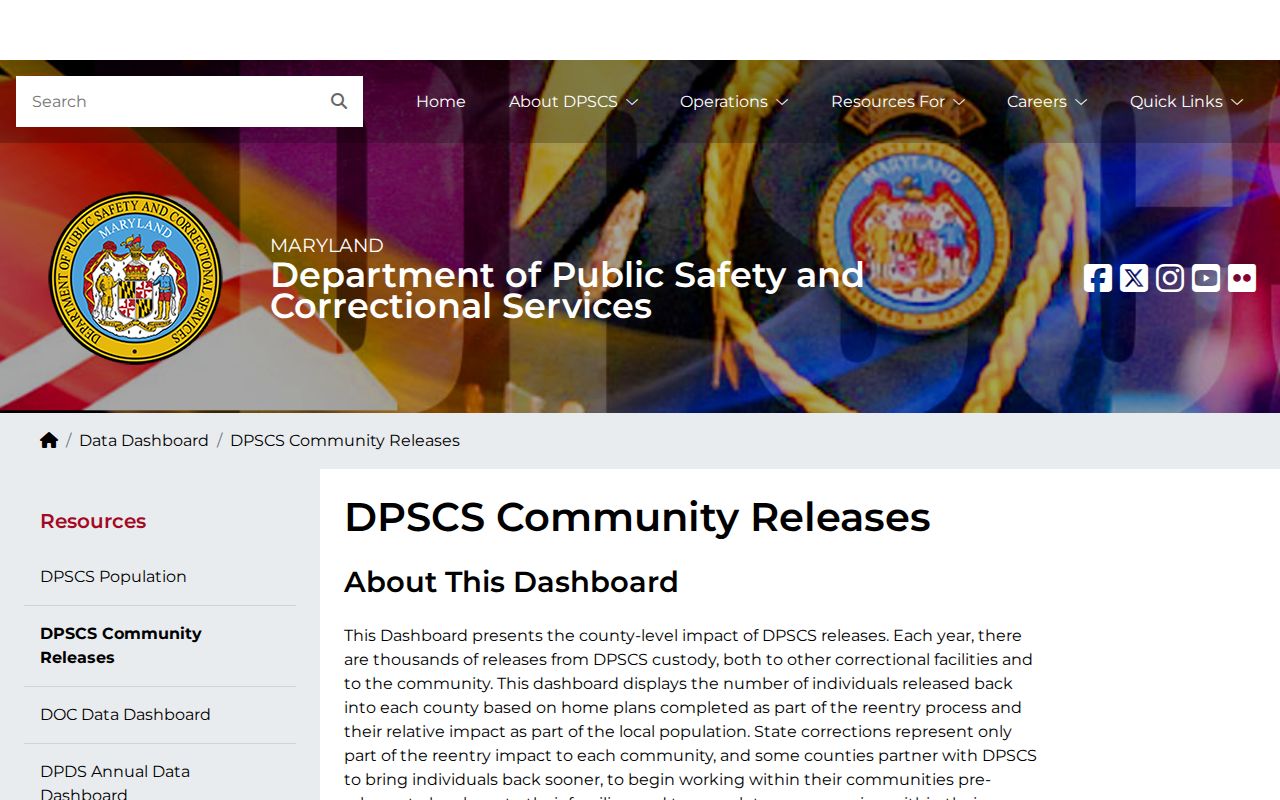
This image supports county-level context only. Individual release verification still belongs with CCDC, DPSCS records, VINE, and the sentencing court.
Confirm Carroll County Actual Release
Once a projected day nears, register through the Carroll County VINELink inmate search for an offered release notice. VINE can report a custody event, but its alert can lag and may describe a transfer. Record the agency, status, and timestamp, then confirm with the custodian.
For a local term, contact the Carroll County Detention Center Inmate Records Unit at 410-386-2628. For a state term, use the DPSCS record process, especially after the person disappears from the public locator. For the legal basis, check the Carroll District or Circuit Court docket. A “closed” case is not itself proof of release.
The final answer may contain more than one date: the order date, calculated date, VINE transmission time, and physical release time. State which date the source actually supplies. That is the sound way to distinguish a Carroll County projected release date from a completed release record.