
CMCF State Release Paths
The official CMCF page identifies Central Maryland Correctional Facility as a Maryland Division of Correction minimum-security and pre-release institution. Its Sykesville location places it within Carroll County, but it is not the county jail. State commitments, prison movements, calculated release information, parole or mandatory release, and final discharge belong to DPSCS.
A resident may leave CMCF through parole, mandatory release, sentence expiration, or transfer to another Maryland prison. Parole is conditional release authorized through the Maryland Parole Commission. Mandatory release is a sentence-based conditional release after applicable diminution credits, usually with supervision for the unserved part. Sentence expiration can end incarceration, although another commitment or detainer may still control what happens next.
Transfer is not release to the community. A current DPSCS locator result naming another institution shows that state custody continued. If the person enters parole or mandatory supervision, the Division of Parole and Probation becomes part of the verification path. An expiration release may end correctional supervision, but the actual record should be checked rather than inferred.
| CMCF departure | Source that confirms it |
|---|---|
| Transfer to another state prison | DPSCS current locator and institutional movement record. |
| Parole | DPSCS release record, Parole Commission material, and DPP supervision information. |
| Mandatory release | DPSCS calculation and release record, with DPP status where applicable. |
| Sentence expiration | DPSCS actual-release and discharge fields. |
| Another legal hold | DPSCS movement record and the receiving authority. |
Confirm a CMCF State Release
Maryland’s Incarcerated Individual Locator is useful only for current covered state custody. The public search takes first and last name. A result naming CMCF or another Maryland institution indicates present state confinement. DPSCS explicitly states that people no longer in custody for any reason are not listed.
- Open the DPSCS locator and enter the legal or committed first and last name.
- Compare the identity and institution carefully; do not rely on a common name alone.
- If another state institution appears, treat the CMCF departure as a transfer.
- If no result appears, do not announce release based on the missing record.
- Check Maryland VINE for an available event and the sentencing docket for legal context.
- Request the historical commitment, movement, calculation, release, and discharge record from DPSCS.
The locator does not show a public projected, tentative, mandatory-release, or maximum-expiration field. It also does not return a former inmate with a “Released” or “Discharged” result. A no-match may reflect release, spelling, timing, another population, or a different custody system. The Carroll County released inmate search explains how to align state records with VINE and court material.
Note: A new Maryland prison in the locator means CMCF custody ended through transfer while the state sentence continued.
CMCF Release Record Fields
The underlying DPSCS institutional record is broader than the public locator. Subject to Maryland law and agency rules, it can include a DOC number, committing court and case, sentence, admission information, institution, movements, calculation fields, parole or mandatory-supervision facts, actual release, and discharge status. These fields answer separate questions and should not be collapsed into one date.
A sentence calculation can contain a mandatory-release or maximum-expiration figure. That internal field does not become a public locator field. Parole eligibility only identifies the first point at which parole may be considered under the applicable law. It is not a promised CMCF release date. An actual-release field records the completed physical event.
| DPSCS field | What it establishes |
|---|---|
| DOC number | The state identifier used to distinguish the correct institutional record. |
| Institution and movements | Where state custody was held and whether CMCF departure was a transfer. |
| Sentence and calculation | The maintained term and applicable release calculations. |
| Release authority and type | Whether the event was parole, mandatory release, expiration, or another action. |
| Actual release date | When DPSCS recorded the completed state-prison release. |
| Supervision or discharge | Whether state correctional control continued in the community or ended. |
A court docket can confirm the sentence and later orders, while Parole Commission material can explain a parole decision. Neither substitutes for the DPSCS movement and actual-release record. When dates differ, name the source and identify whether it is an order, calculation, eligibility point, event transmission, or completed release.
CMCF Records and Contact
CMCF can answer properly routed facility questions, but a formal state records request is the stronger documentary path for a former resident. Submit a focused request through the DPSCS Public Information Act office or email dpscs.pia@maryland.gov. Include the DOC number if known, committing court and case, likely institution, and approximate dates.
Central Maryland Correctional FacilityMaryland Division of Correction
7301 Buttercup Road
Sykesville, MD 21784
410-781-4444
Specify the nonexempt fields needed: admission, institutional movements, calculation sheet, mandatory-release date, parole or release authority, actual release date, release type, and supervision or discharge status. Former incarcerated people seeking their own base file or medical file are directed by DPSCS to the releasing institution or the Case Management Office for Operations at 410-585-3300.
Third-party requests remain subject to privacy, security, medical, investigative, and other lawful exemptions. Ask for all reasonably segregable nonexempt portions and the stated basis for any withholding. A telephone statement from a facility employee should not be expanded beyond what the employee actually confirmed.
The official CMCF facility source is also the subject of the facility manifest image.
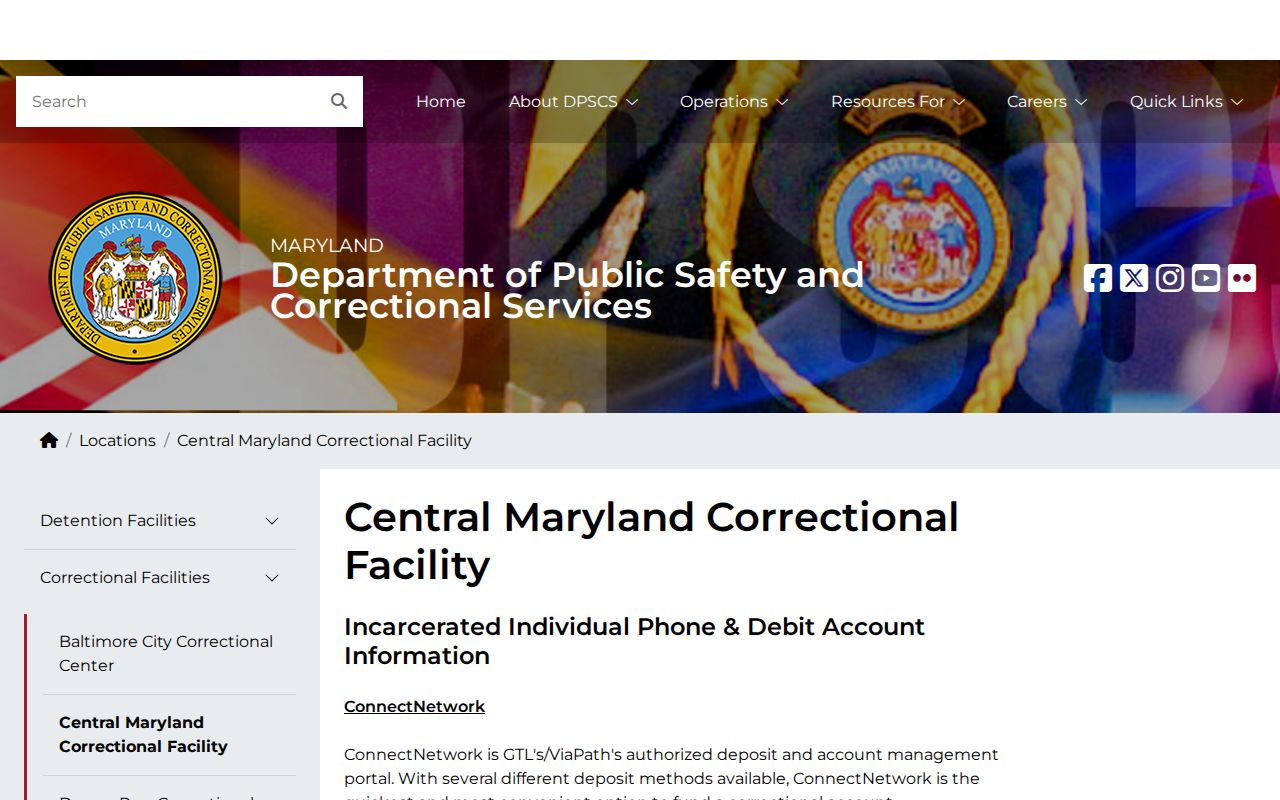
The image establishes CMCF’s state identity, contact, and pre-release designation. It does not create a public archive of former CMCF residents.
CMCF Parole and Mandatory Release
A CMCF community release can continue under state correctional control. The Maryland Parole Commission decides parole suitability and handles specified revocation matters. The Division of Parole and Probation supervises parole, mandatory release, and court-ordered probation, though probation can arise without any CMCF stay.
- Parole
- Conditional release during a prison sentence after Commission action.
- Mandatory release
- Conditional release produced by the term less applicable diminution credits.
- Mandatory supervision
- Community supervision for the unserved balance after mandatory release.
- Probation
- Supervision ordered by a court, separate from the prison release authority.
- Discharge
- The end of the relevant sentence or correctional supervision authority.
No public statewide person-name parolee or probationer lookup was found. Do not infer supervision from an old report or from a DPSCS locator no-match. The sentencing docket and appropriate DPP office are the public verification route, subject to what the agency may disclose. The Parole Commission documents parole proceedings but does not turn an eligibility date into a guaranteed release.
A detainer can also redirect release. A detainer is a request or hold from another authority. DPSCS may relinquish one form of custody while another agency takes the person. The state movement record and receiving agency must be checked before describing the event as release to the community.
CMCF and Carroll Jail History
CMCF opened in 1960 as a state facility in Sykesville. It is distinct from Carroll County’s downtown jail history. The Carroll Sheriff’s history explains that the 1837 Historic Jail is now administrative space, while the operating Carroll County Detention Center dates to 1971. Neither building is CMCF, and county-jail history must not be used to describe a state-prison release location.
A Carroll County fiscal year 2027 capital document describes a planned 82,000-square-foot, 300-bed county jail replacement. That project concerns the Carroll County Detention Center, not CMCF. It does not change CMCF’s address, operator, or DPSCS records path.
This distinction matters when searching by geography. A person at CMCF is in a Maryland Division of Correction institution situated in Carroll County. The Carroll Sheriff cannot certify a CMCF discharge just because both facilities are in the same county. State release facts remain with DPSCS.
Note: Future changes to Carroll County’s local jail do not alter CMCF’s status as a separate Maryland state prison.
CMCF State Record Boundaries
The current locator, historical state record, parole record, supervision information, and court docket each answer a distinct question. The locator can show a current institution. The historical record can document movements and completed release. The Parole Commission can explain a parole action. DPP may confirm the correct supervision office within disclosure limits. The court provides the sentence and judicial orders.
Maryland VINE may supply a recent event, but it is not a permanent certified archive. Source materials are not fully uniform about every intrastate transfer alert. Use the live event choices and rely on the DPSCS locator for a current Maryland facility. Preserve the agency name and event time if VINE reports a release.
A former CMCF resident will not remain in the public DPSCS locator. The correct fallback is a precise DPSCS request, not the Carroll County Detention Center and not a county roster. A final statement should distinguish transfer, conditional community release, sentence expiration, and full discharge without treating those terms as synonyms.